



Acoustic Energy AE1 Active
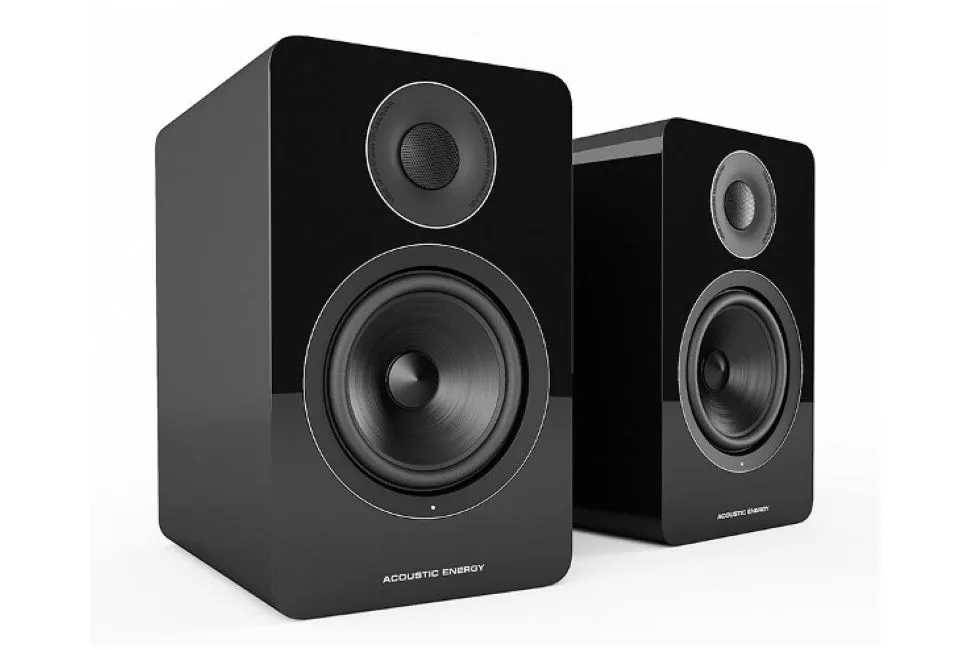
Active 2-way bookshelf speaker from Acoustic Energy, with integrated class A/B amplification and aluminium ceramic cone, for direct connection to a DAC or a streamer.
Description
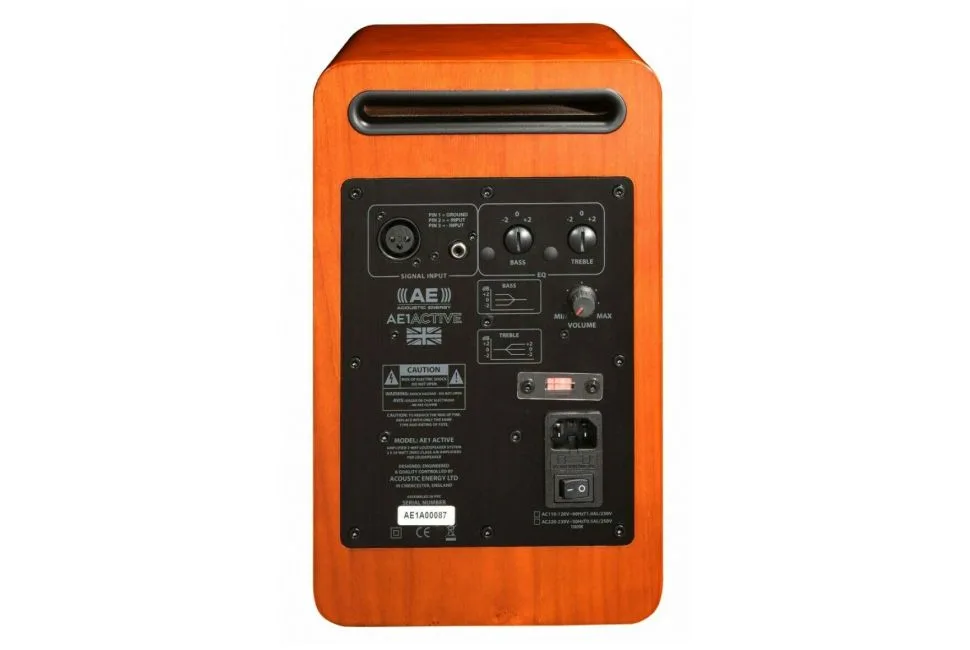
The AE1 Active is a fully active two-way bookshelf speaker, meaning it has its amplification and filters built into the cabinet. It connects directly to an analogue source, a DAC or a streamer, without going through an external amplifier or separate speaker cables.
Each driver pairs a 125 mm aluminium ceramic sandwich cone with a 25 mm aluminium dome tweeter, both driven separately by two 50 watt class A/B amplifiers per speaker, powered by a linear power supply. This bi-amplified design, with a crossover point set at 3.5 kHz using a 4th order Linkwitz-Riley filter, allows the signal to be precisely split between bass/midrange and treble and limits the losses usually associated with passive filtering. The frequency response spans from 42 Hz to 28 kHz (+/-6 dB), with an input sensitivity of 104 dB for 1 VRMS at 1 kHz and a maximum SPL of 115 dB. The cabinet is made of 18 mm MDF, reinforced with bracing and damping panels to limit cabinet resonances.
This model is intended for near-field listening, on a desk or in a small room, for a user wanting a compact system connected directly to a digital or analogue source without additional separate electronics.
Technical specifications
| Maximum SPL | 115 dB |
| Power | 100 W |
| Frequency range | 42 Hz – 28 kHz (+/-6 dB) |
| Input sensitivity | 104 dB for 1 VRMS at 1 kHz |
| Crossover frequency | 3.5 kHz, 4th order Linkwitz-Riley |
| Amplifier | Class A/B with linear power supply |
| Driver unit | 125 mm aluminium ceramic sandwich cone |
| Tweeter | 25 mm aluminium dome |
| Design | 2-way active |
| Cabinet | 18 mm MDF with bracing and damping panels |
| Dimensions (H × W × D) | 300 x 185 x 250 mm |
| Weight | 18 kg (the pair) |
What to check before buying used
With an active speaker, the built-in electronics deserve inspection above all: check that both class A/B amplification channels work without hiss, hum or intermittent cutting out, particularly after a warm-up period. The XLR and RCA inputs, as well as the internal wiring connecting the amplifier to the drivers, should be tested with each type of connection. A visual check of the aluminium ceramic cone and tweeter dome allows any deformation or dent caused by poor storage to be identified.
Looking for this reference: AE1 ?
Tell us what you are looking for: our merchants are notified, and one of them may have it in stock.