
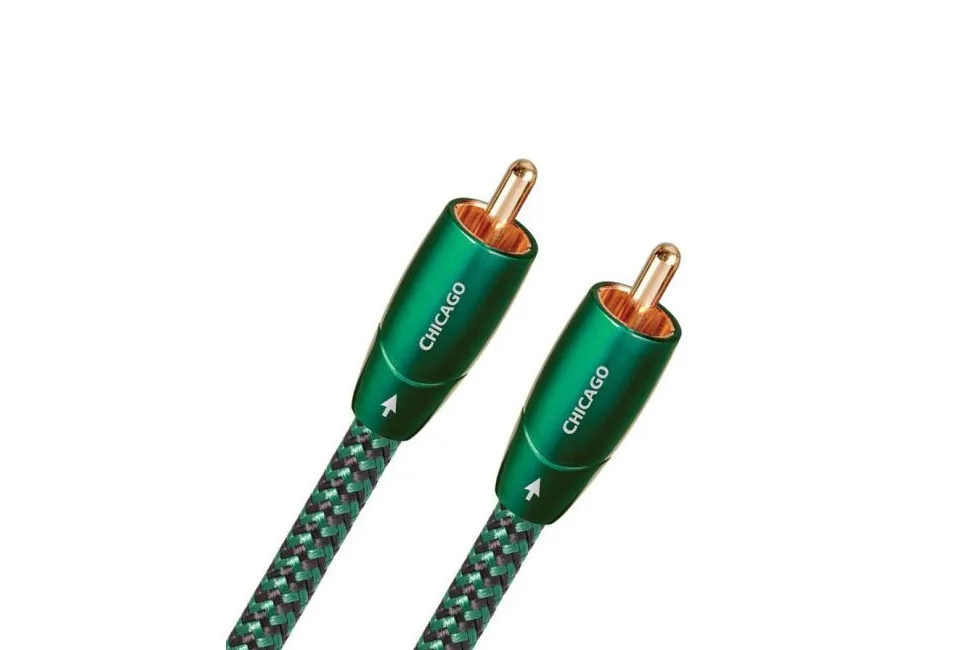

AudioQuest Chicago
AudioQuest Chicago RCA interconnect cable with solid LGC copper conductors, designed to connect sources and amplifiers with careful signal transmission.
Description
The Chicago is an RCA interconnect cable from AudioQuest, designed to connect an audio source (player, turntable with preamp, DAC) to an amplifier or mixing desk. It belongs to the category of analogue interconnect cables aimed at hi-fi systems where signal transmission quality matters.
This model is built with solid Long Grain Copper (LGC) conductors, a long-grain copper that limits internal junction points which could otherwise degrade the signal. Insulation is provided by nitrogen-injected polyethylene foam, a technique that reduces the cable's capacitance and preserves the coherence of the transmitted signal. AudioQuest also incorporates its proprietary NDS (Noise-Dissipation System) technology, an RFI filtering system designed to dissipate radio-frequency interference picked up by the cable. The cable's symmetrical structure helps balance the electrical behaviour of both conductors.
The RCA connectors are gold-plated and cold-welded, a mechanical fixing process that avoids the need for soldering and aims for a stable, long-lasting connection.
This cable is aimed at hi-fi enthusiasts who want to ensure a quality connection between their components without resorting to digital solutions or generic cable, particularly in setups where the source and amplifier are close to one another.
Technical specifications
| Conductors | Long Grain Copper (LGC), solid |
| Insulation | Nitrogen-injected polyethylene foam |
| RFI filtering | NDS (Noise-Dissipation System) technology |
| Structure | Symmetrical |
| Connectors | Gold-plated, cold-welded |
What to check before buying used
The cold-welded connectors deserve a visual inspection: look for any trace of oxidation or play in the gold plating, which should remain uniform and free of pitting. Check that the sheath and symmetrical structure have not been sharply bent or crushed, as this can crack the polyethylene foam insulation and alter the cable's capacitance. A continuity test at both ends will confirm that the NDS shielding and LGC conductors have not suffered any internal break invisible to the eye.
Looking for this reference: Chicago ?
Tell us what you are looking for: our merchants are notified, and one of them may have it in stock.