

Audiovector K1
Two-way bookshelf speaker with bass-reflex loading, manufactured in Denmark, intended for carefully considered installations where space must remain limited.
Description
The K1 occupies the compact slot in Audiovector's catalogue: a two-way bookshelf speaker, designed and manufactured in Denmark, intended to be placed on dedicated stands or a solid shelf rather than on the floor. It is aimed at those who want a complete listening source without installing floorstanding speakers in the room.
Its architecture relies on two transducers developed by the brand, a tweeter and a woofer-midrange, combined in a bass-reflex loading. This type of loading exploits the tuning of the port to extend the bass response despite a limited cabinet volume, which explains why it is so often found on compact formats. The trade-off is well known: the speaker remains sensitive to its surroundings, and placement too close to a wall can overload the lower end of the spectrum.
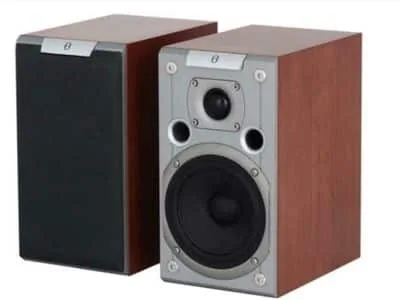
The distinctive feature of the K1 lies in the way its drivers are fixed: they are mounted on a metal plate, whose role is to limit the reflections generated by the baffle and the edges of the cabinet. These parasitic reflections, which overlay the direct signal with a slight delay, blur the clarity of transients and the stability of the soundstage. A rigid baffle treated in this way therefore works both on clarity and on the precision of the soundstage.
This profile suits close listening in a living room or medium-sized room, in a classic stereo system, where finesse and tonal coherence are favoured over raw volume. The use of rigid stands and positioning at a reasonable distance from rear walls is an integral part of setting up this type of compact speaker.
When buying used, a few checks are specific to this type of speaker:
- Examine the suspension and cone of the woofer-midrange: look for cracks, deformation, or separation at the junction with the basket.
- Check the tweeter dome, particularly vulnerable to dents caused by handling without a protective grille.
- Check the fixing of the drivers to their metal plate: loose screws or a worn gasket cause parasitic noise and reduce the cabinet's airtightness.
- Inspect the bass-reflex port, which must remain clear and intact, and listen at moderate volume to detect any breathing or resonance noises.
- Check the condition of the terminals, often oxidised, and the finish of the cabinetwork, particularly the edges and corners, which are sensitive to transport damage.
Listening to both speakers paired together, using tracks with voices and pronounced transients, remains the best way to ensure the pair is consistent and that neither the crossover nor the drivers have drifted.
Technical specifications
| Type | Two-way bookshelf speaker |
| Loading | Bass-reflex |
| Drivers | Audiovector tweeter and woofer-midrange |
| Design | Drivers mounted on metal plate (reflection limitation) |
| Manufacturing | Denmark |
Looking for a specific product?
Tell us what you are looking for: our merchants are notified, and one of them may have it in stock.