
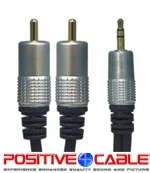
Positive Cable Premium Libra Mini
A 3.5 mm mini-jack interconnect cable from Positive Cable, designed to connect a portable audio source to an amplifier.
Description
The Positive Cable Premium Libra Mini is an interconnect cable fitted with a 3.5 mm mini-jack connector, intended to connect a portable audio source (CD player, MiniDisc, computer) to an amplifier. It forms part of a range of cables designed to preserve signal quality between portable devices and hi-fi systems.
The connector is made of copper plated with 24-carat gold to a thickness of 6 microns, ensuring stable contact and limiting oxidation over time. The conductor uses high-purity oxygen-free copper (HPOFC), while an optimised dielectric, named PDCC™, aims to reduce distortion at high frequencies. The internal structure, referred to as FluxCapacitor™, is designed for accurate, time-coherent signal transfer across a wide bandwidth.
The shielding combines a copper braid with an aluminium foil, with the connector itself connected to earth: this double protection aims to limit electromagnetic interference, a sensitive point for a short cable intended for portable use, often near other electronic devices. The solder joints, made with molten tin and hand-finished, are intended to strengthen the connection between the cable and the connector, complemented by a system designed to protect against the strain of repeated plugging and unplugging.
This cable is aimed at those wishing to connect a portable player, a computer or any other device fitted with a mini-jack output to an amplifier, without going through a conventional RCA output. It is particularly suited to mixed setups combining portable digital sources with a traditional hi-fi system.
What to check before buying used
With this type of cable, the sensitive points are at the ends: check that the mini-jack connectors show no play or visible oxidation, a sign of poor storage. The internal solder joints, made with molten tin, can weaken over the years and cause micro-cuts or a channel that cuts out intermittently. The shielding sleeve should also be inspected along its entire length, looking for pronounced kinks or crushed areas that could compromise protection against electromagnetic interference.
Looking for this reference: Positive ?
Tell us what you are looking for: our merchants are notified, and one of them may have it in stock.