
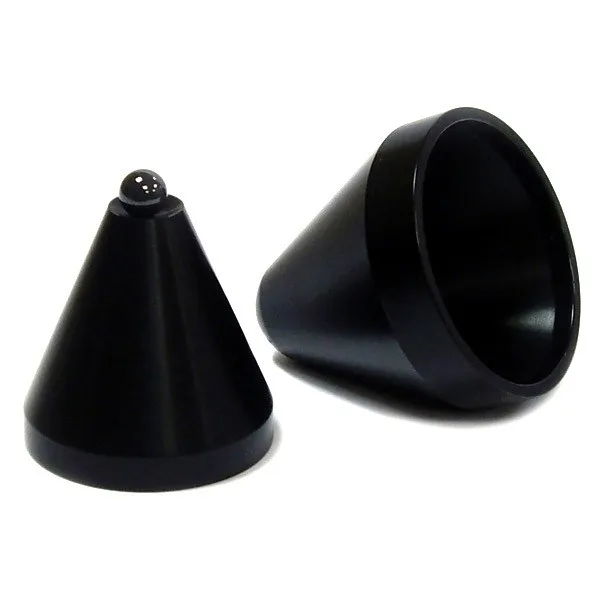
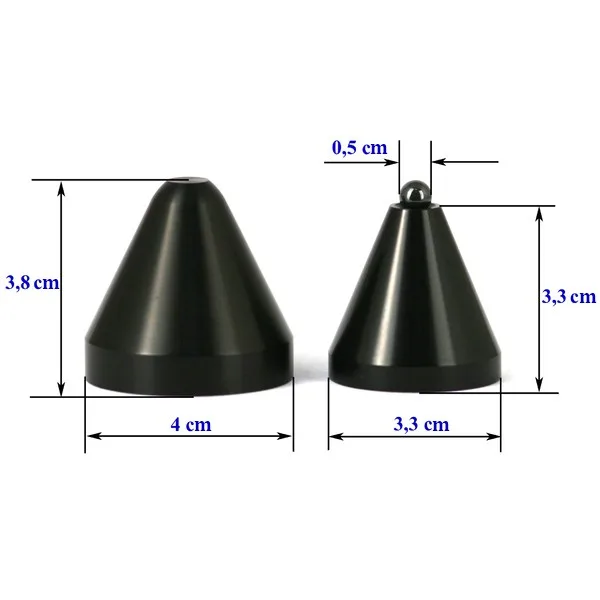

Cold Ray Ceramic Absorbing Resonator
Cold Ray decoupling stand with a ceramic ball running between two cones, designed to isolate speakers, players and electronics from vibrations and resonances from the support surface.
Description
The Ceramic Absorbing Resonator from Cold Ray is an anti-vibration stand that sits between an audio component and its supporting surface. It is intended for speakers as well as players and electronics, with a dual purpose: preventing the equipment's own vibrations from spreading, and limiting resonances fed back from the floor or the piece of furniture.
Its operation relies on a free ball held between an inner cone and an outer cone. By rotating within its housing, this ball redirects the force vectors and allows vibrations to be dealt with regardless of their direction, not only along the vertical axis. This is what sets the principle apart from more conventional solutions such as rubber pads or rigid spikes. The manufacturer also highlights the vertical stability of the assembly, which remains steady even under significant loads.
The version described here uses a ceramic ball, a material chosen for its damping properties, making it a consistent choice for an accessory dedicated to controlling resonances. Cold Ray also offers a steel ball version, more affordable, which already deals with the bulk of the resonances encountered.
Setting it up calls for a few precautions. These stands are designed to sit on a hard, rigid surface: on a soft support, the principle loses its point. Placement matters as much as quantity: it is best to position the cones under the areas where mass is concentrated, typically directly beneath a transformer or a heatsink. On a CD or DVD player, the natural reference point is the disc transport block.
This type of accessory is aimed at the listener who has already settled on speaker placement and is looking to clean up the mechanical coupling of their system. The expected result is a clearer message and a tighter bass, as the equipment is no longer disturbed by parasitic vibrations.
What to check before buying used
The proper operation of the ball-and-cones pair deserves careful checking: the ceramic ball must roll freely within its housing, with no rough spots or excessive play, and must show no chips or cracks on its surface. Also inspect the inner and outer cones, whose bearing surfaces can mark or become oval-shaped after years under heavy load. A stand that rocks or has lost its vertical stability has lost its acoustic value, even if it remains presentable in appearance.
Looking for this reference: Ceramic Absorbing resonator ?
Tell us what you are looking for: our merchants are notified, and one of them may have it in stock.