

Davis Basson 77
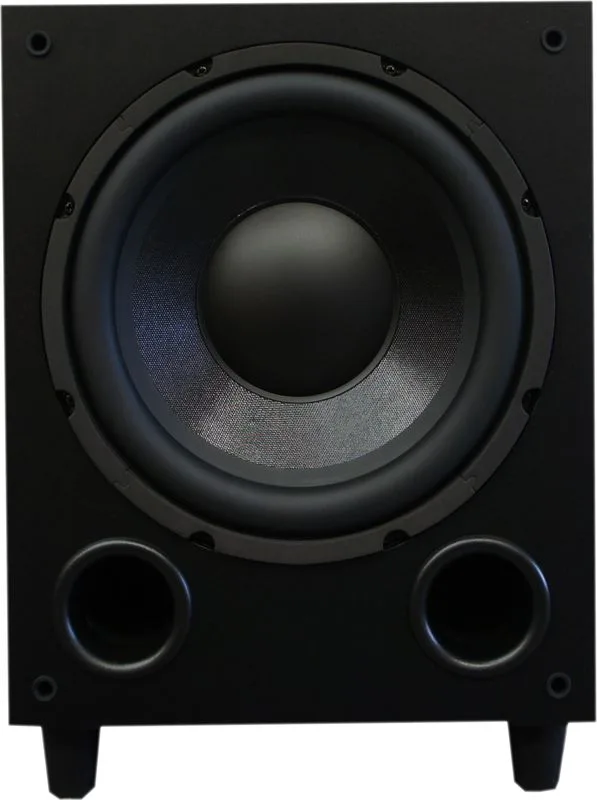
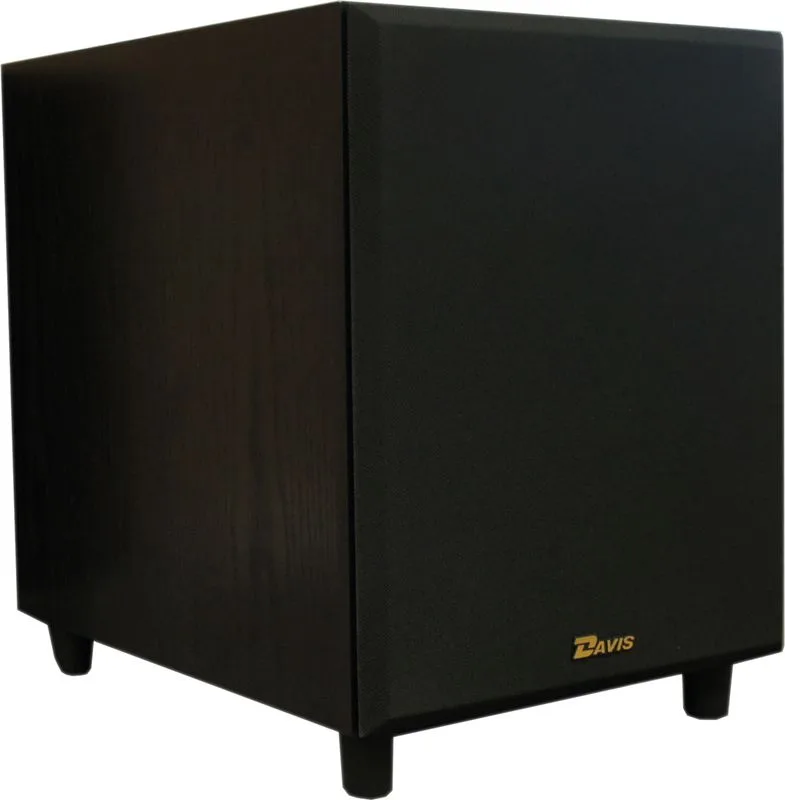
Amplified subwoofer Davis Basson 77, with treated cellulose fibre cone, Class D amplification and adjustable crossover frequency.
Description
The Davis Basson 77 is an amplified subwoofer designed to reinforce the low-frequency register of a hi-fi or home cinema installation. It features its own amplifier, allowing it to operate independently without a dedicated external power stage for low frequencies.
The cone is made of treated cellulose fibre, a material valued for its good compromise between lightness and rigidity. The high-pass crossover frequency can be set from 30 to 120 Hz, allowing the crossover point with the main speakers to be adjusted according to their own low-frequency extension. The subwoofer goes down to a minimum frequency of 25 Hz. A phase setting, switchable between 0 and 180°, helps bring the subwoofer into time coherence with the rest of the system in order to avoid wave cancellations. An automatic incoming signal adjustment function is also provided.
On the connectivity side, the Basson 77 has two RCA inputs, usable as LINE IN or LFE depending on the configuration chosen (stereo or home cinema). The internal amplification, of the Class D type, delivers a maximum power of 600 W, a figure that demonstrates the subwoofer's ability to produce firm bass without requiring an additional amplifier.
This type of subwoofer is intended for a user wishing to complement a pair of stereo speakers with little or no bass extension, or to structure the LFE channel of a home cinema installation. The presence of both types of inputs makes it a model adaptable to several uses without changing the wiring.
Technical specifications
| Brand | Davis |
| Cone | Treated cellulose fibre |
| High pass crossover frequency | 30 to 120 Hz |
| Minimum frequency | 25 Hz |
| Phase setting | 0 or 180° |
| Amplification | Class D |
| Power | 600 W max |
| Connectivity | 2 RCA inputs (LINE IN or LFE) |
What to check before buying used
The treated cellulose fibre cone should be examined under raking light for cracks, deformation or traces of moisture, and the surround is worth pressing with a finger to check that it is not hardened or split. The internal Class D amplification may show background noise, hum or thermal cut-outs after several minutes of operation, a sign of a tired electronic module. It is also worth testing the phase setting (0/180°) and the crossover frequency potentiometer, whose tracks oxidise over time and cause crackling or dead spots when turned.
Looking for this reference: Basson 77 ?
Tell us what you are looking for: our merchants are notified, and one of them may have it in stock.