
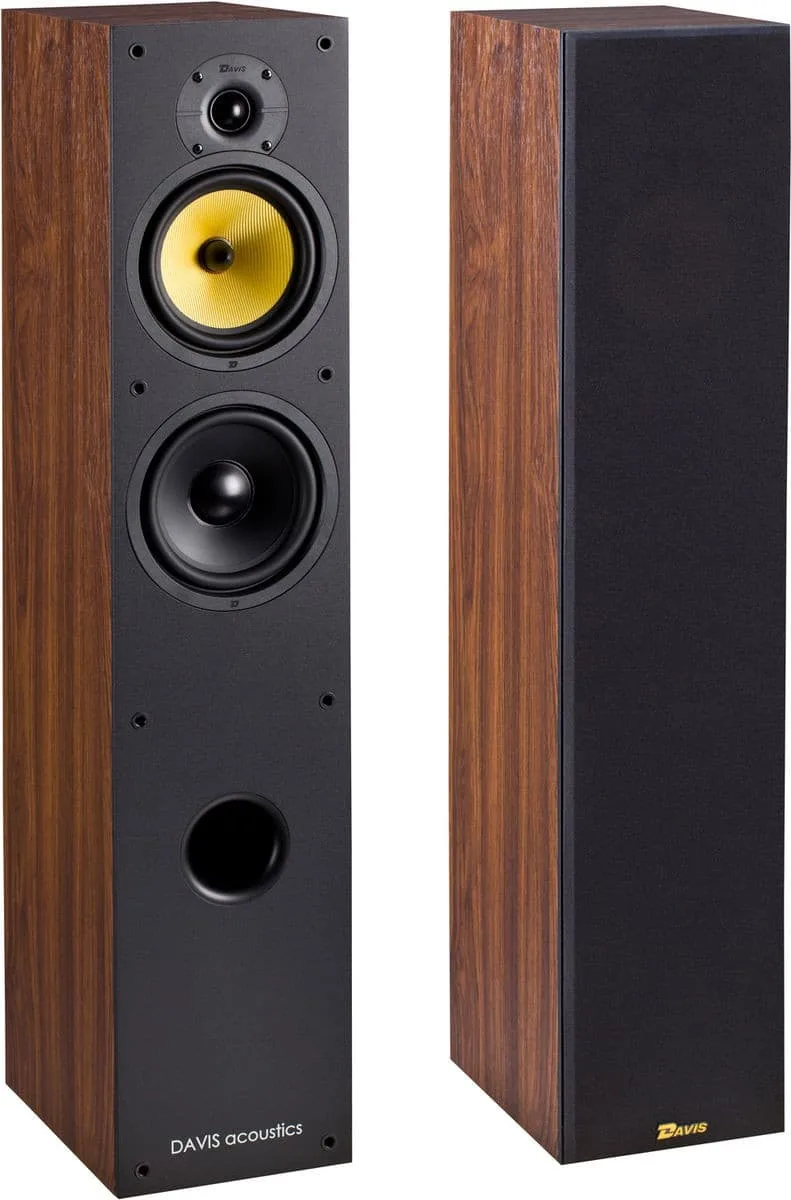

Davis Maya Teak
3-way bass-reflex floorstanding speaker, 17 cm cellulose woofer and 25 mm fabric tweeter, teak finish, for versatile hi-fi listening in the living room.
Description
The Maya Teak is a 3-way floorstanding speaker with bass-reflex loading, designed for a domestic stereo installation. Its front-firing port frees up the space behind the cabinet, allowing it to be positioned close to a wall without the bass being disturbed by reflections or unwanted pressure build-up.
The bass is handled by a 17 cm driver with a cellulose cone, while the midrange relies on a second 17 cm driver with a fibreglass cone, a material lighter and stiffer than classic cellulose, sought after to limit distortion in this frequency band. The top of the spectrum is handled by a 25 mm soft dome tweeter. The crossover frequencies, set at 300 Hz and 3,000 Hz, define the division of work between the three drivers. The stated frequency response ranges from 45 Hz to 21 kHz, with a sensitivity of 91 dB and an impedance of 4-8 Ω, compatible with most integrated amplifiers on the market. The power handling is 80 W RMS, with a possible peak of 120 W.
This floorstanding speaker is aimed at a listener wanting a genuine three-way hi-fi speaker for a living room, for classic stereo listening, without a need for extreme power but with a focus on accuracy across the whole spectrum. Its teak finish also makes it a suitable choice for an interior where audio furniture needs to blend in visually.
Technical specifications
| Type | 3-way floorstanding speaker, bass-reflex (front-firing port) |
| Drivers | 17 cm cellulose woofer + 17 cm fibreglass midrange + 25 mm fabric tweeter |
| Sensitivity | 91 dB |
| Impedance | 4-8 Ω |
| Frequency response | 45 Hz – 21 kHz |
| Crossover frequencies | 300 Hz / 3,000 Hz |
| Power | 80 W RMS (120 W peak) |
| Dimensions (W × H × D) | 190 × 900 × 270 mm |
| Weight | 15 kg |
| Finish | Teak |
What to check before buying used
The suspensions of the two 17 cm drivers deserve a visual check: hardened, cracked or sticky foam or rubber indicates age and affects the rendering of both bass and midrange. The exposed tweeter dome should be checked by eye to rule out any dents or tears. The front bass-reflex port should be checked to ensure no internal element has come loose and rattles inside the duct. Finally, the teak cabinetry should be examined for chips, veneer lifting or warping of the rear panel.
Looking for a specific product?
Tell us what you are looking for: our merchants are notified, and one of them may have it in stock.