

ELAC 2060 D
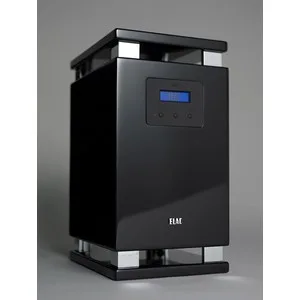
ELAC 2060 D subwoofer with mirror finish, featuring LLD technology and a front-panel graphic interface.
Description
The SUB 2060 D is a subwoofer from ELAC, designed to complement a stereo or home cinema system by providing reinforcement at low frequencies. Its mirror finish and compact dimensions allow it to blend discreetly into a lounge or listening room, without imposing significant visual bulk.
This model is based on LLD technology, a principle of driver isolation intended to limit unwanted vibrations from the cabinet itself. The aim is to reproduce bass with as little distortion as possible, preventing cabinet resonances from blurring the low-frequency signal.
Another distinctive feature of this subwoofer: it incorporates three microcontrollers that manage the internal analogue electronics. New for this model, these microcontrollers also drive a new graphic interface, with a high-resolution display and three control buttons on the front panel, allowing adjustments to be made directly on the unit.
The SUB 2060 D is aimed at a user seeking a subwoofer that is both compact and aesthetically refined, for a system where visual integration matters as much as bass reproduction quality. Its mirror finish makes it a fitting choice for interiors where the appearance of audio equipment matters.
Technical specifications
| Type | 1-way, active, 2 woofers in sealed enclosure |
| Woofer | 2x 180 mm AS cone |
| Frequency response | 29 – 240 Hz |
| Crossover frequency | 40 – 180 Hz adjustable |
| Input impedance | Line: 35 kOhms, Speaker: 220 Ohms floating |
| Power | 330 W (Pulse) |
| Signal to noise ratio | >100 dB (A) relative to full power |
| Inputs | Line: 1 x 200 mV (RCA), 2x 200mV (XLR); Speaker: 3 x 2.5V, 1x remote start (3.5 mm jack) |
| Power supply | 90 – 240 V ~ / 50...60 Hz, fuse T 6.3 A L 250 V |
| Consumption | Max. 0.5 W in standby, max. 400 W at full load |
| Weight | 16.5 kg |
What to check before buying used
Check the seal of the driver's dampers responsible for LLD isolation: sagging or hardening of these suspensions encourages the cabinet resonances that this system is meant to eliminate. Systematically test the display and the three front-panel buttons, as these microcontrollers and this recent graphic interface are more prone to electronic wear than a simple analogue potentiometer. Finally, examine the mirror finish, which is particularly exposed to micro-scratches and chipping.
Looking for this reference: 2060 D ?
Tell us what you are looking for: our merchants are notified, and one of them may have it in stock.