



Marantz SACD 30n
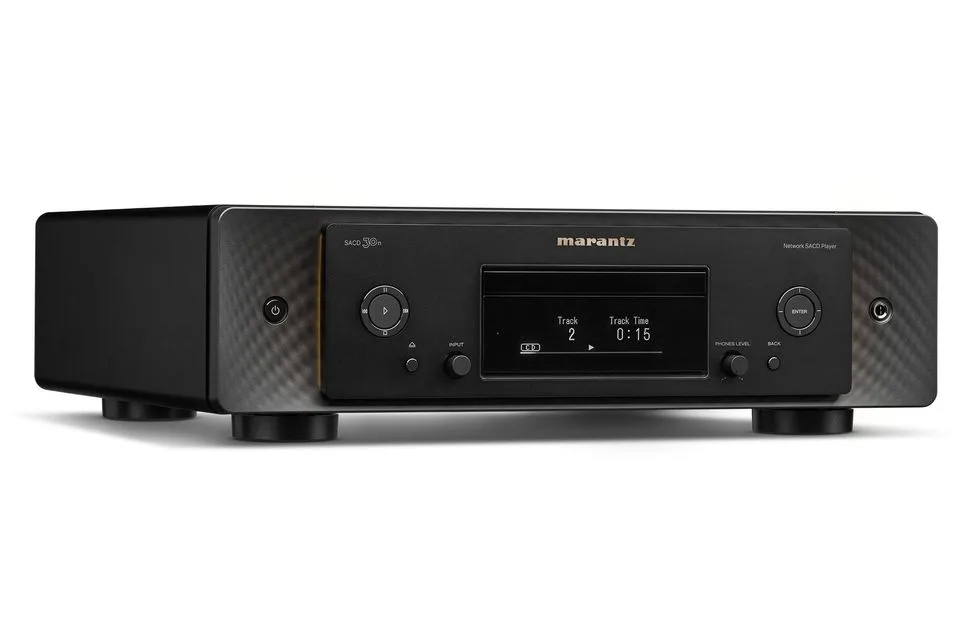
Complete digital source from Marantz: CD/SACD player, HEOS network streamer, USB-B converter and headphone amplifier combined in a 13.5 kg aluminium chassis.
Description
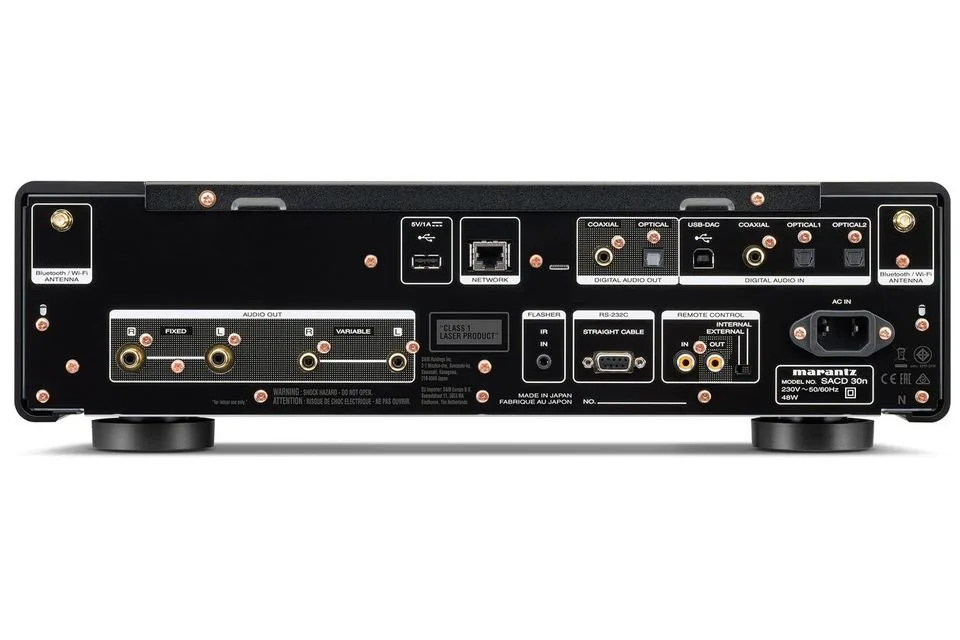
The SACD 30n is the complete digital source in the Marantz catalogue: it plays CDs and SACDs thanks to an in-house SACD-M3 metal transport mechanism, connects to the network via the HEOS platform (Wi-Fi, AirPlay 2, Bluetooth, DLNA) to access web radio and streaming services, serves as an external converter for a computer via USB-B, and features a standalone headphone stage. A single unit thus covers discs, stored files and online listening.
On the conversion side, the chip accepts PCM up to 32-bit/384 kHz and DSD up to 11.2 MHz, allowing playback of the most demanding files without restricted resampling, in formats ranging from MP3 to DXD and DSF, as well as FLAC, ALAC, WAV and AIFF. Marantz Musical Mastering processing and discrete HDAM modules (HDAM SA3 on the line output, HDAM SA2 paired with HDAM for the headphone stage) handle the analogue stage, powered by a toroidal transformer within an aluminium chassis. The measurements reflect this care given to the analogue section.
- Frequency response: 2 Hz to 20 kHz
- Dynamic range: 109 dB in SACD, 98 dB in CD
- Signal-to-noise ratio: 112 dB in SACD, 104 dB in CD
- Channel separation: 105 dB in SACD, 100 dB in CD
- Total harmonic distortion at 1 kHz: 0.0008% in SACD, 0.0015% in CD
Two outputs coexist: a low-noise fixed level intended for an integrated amplifier or a preamplifier, and an independent variable output that allows active speakers or a power amplifier to be driven directly, without an additional link in the chain. The unit can be controlled via remote control, an app or voice assistant, and the headphone output offers adjustable gain to suit varying impedances.
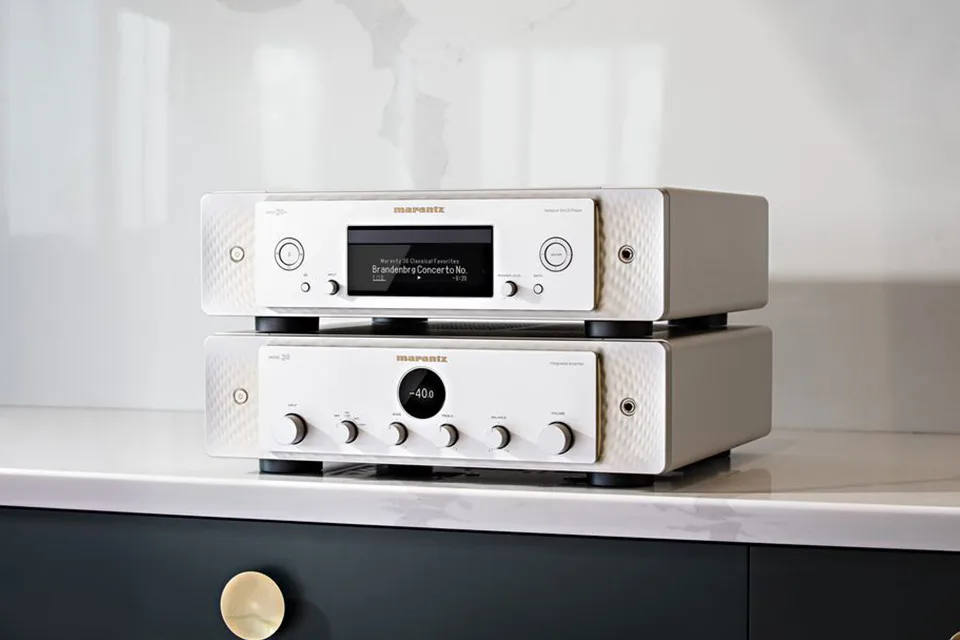
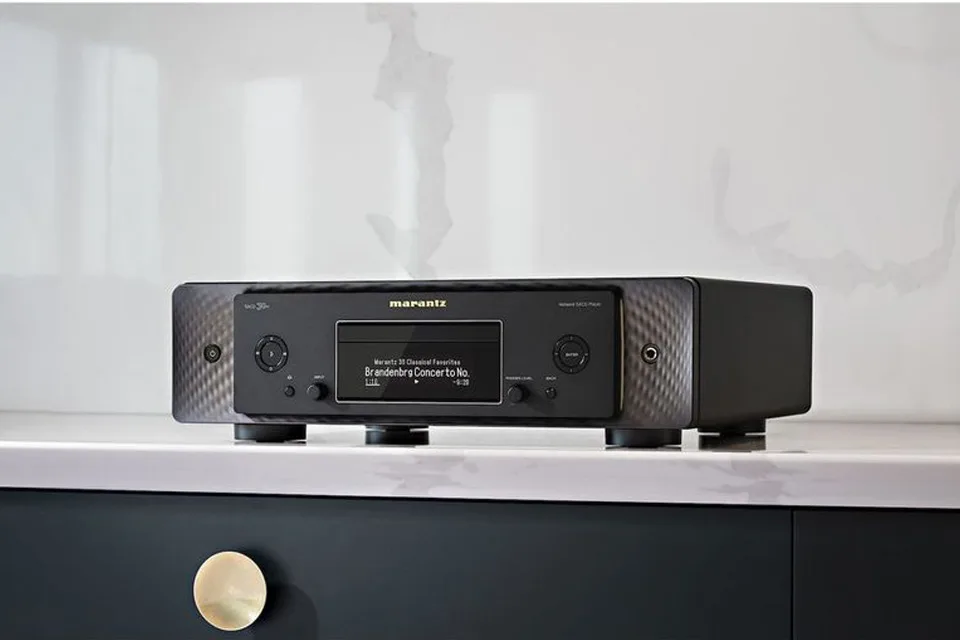
This model is aimed at the listener with a substantial physical CD and SACD collection who also listens online, and who wants a single source component rather than a player, a streamer and a DAC stacked together. Its 443 × 130 × 424 mm dimensions and 13.5 kg weight call for a sturdy piece of furniture and a deep shelf; its aesthetics and format naturally suit pairing with an integrated amplifier from the same range.
Technical specifications
| Frequency response | 2 Hz to 20 kHz |
| Dynamic range SACD | 109 dB |
| Dynamic range CD | 98 dB |
| Signal to noise ratio SACD | 112 dB |
| Signal to noise ratio CD | 104 dB |
| Channel separation SACD | 105 dB |
| Channel separation CD | 100 dB |
| Total harmonic distortion SACD | 0.0008% (1 kHz) |
| Total harmonic distortion CD | 0.0015% (1 kHz) |
| Transport mechanism | SACD-M3 (metal) |
| Converter | 32-bit / 384 kHz and DSD 11.2 MHz |
| Headphone stage | Buffer (HDAM SA2 + HDAM), current feedback |
| Buffer output | HDAM SA3 |
| File formats | MP3, WMA, AAC, FLAC, ALAC, WAV, AIFF, DXD, DSD (.DSF) |
| Network connectivity | Wi-Fi, HEOS, AirPlay 2, Bluetooth, DLNA |
| Power supply | Toroidal transformer |
| Chassis | Aluminium |
| Dimensions (W × H × D) | 443 × 130 × 424 mm |
| Weight | 13.5 kg |
What to check before buying used
The point to check remains the SACD-M3 transport mechanism: ask for a playback test on a burnt CD and on an SACD, with the tray loaded and unloaded several times, listening for carriage noise and checking for skipping or disc recognition errors. Then check the network side, which depends on firmware: the unit must connect via Wi-Fi, be detected by the HEOS app and accept a firmware update, otherwise certain streaming services may have stopped working. Test the headphone output at low and high gain, as well as switching between fixed and variable output, two functions rarely tried during a quick trial. Finally, given the 13.5 kg weight and aluminium chassis, inspect the front panel and the tray for any signs of transport damage.
Looking for this reference: SACD 30n ?
Tell us what you are looking for: our merchants are notified, and one of them may have it in stock.