
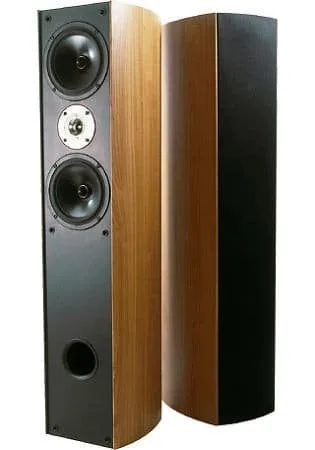

Mosscade MF12 Ash
2-way floorstanding speaker with D'Appolito architecture, horn-loaded tweeter and dual 14 cm woofer-midrange, ash finish, for high-efficiency listening.
Description
The Mosscade MF12 Ash is a 2-way bass-reflex floorstanding speaker, built according to a D'Appolito architecture: two woofer-midrange drivers symmetrically flank the tweeter, an arrangement designed to achieve better vertical sound dispersion coherence compared with a conventional layout.
The two 14 cm woofer-midrange drivers, with treated paper cones, handle the reproduction of bass and midrange, while the compression-chamber horn-loaded tweeter takes charge of the treble. This type of tweeter, inherited from PA sound technologies, is distinguished by a high efficiency and an ability to reproduce sharp transients. The bass-reflex loading, with a front-firing port, completes the bass extension. The 91 dB sensitivity means the speaker delivers a high sound level for a given amplification power, making it compatible with moderate-power amplifiers. The 4 Ω nominal impedance, however, requires an amplifier capable of driving this load without difficulty. The frequency response extends from 46 Hz to 22 kHz, and the power handling is 120 W.
This type of design, with its high efficiency and pronounced dynamics, is aimed at listeners seeking an energetic and forward-sounding listen, with a good ability to convey rhythmic nuances. The ash finish suits an interior where a natural wood look is desired.
Technical specifications
| Type | 2-way floorstanding speaker (d'Appolito), bass-reflex |
| Drivers | 2 treated-paper mid-woofers 14 cm + horn tweeter (compression chamber) |
| Sensitivity | 91 dB |
| Impedance | 4 Ω |
| Frequency response | 46 Hz – 22 kHz |
| Power handling | 120 W |
| Finish | Ash |
What to check before buying used
On this type of bass-reflex loading, check the condition of the surrounds on both 14 cm woofer-midrange drivers: sagging or excessive softness of the foam indicates ageing that affects bass performance. Also inspect the horn of the compression-chamber tweeter, which is prone to knocks and cracks, as well as the front bass-reflex port to rule out any sealing defects. Finally, examine the ash cabinet, particularly the corners and veneer, for any signs of knocks or lifting.
Looking for a specific product?
Tell us what you are looking for: our merchants are notified, and one of them may have it in stock.