
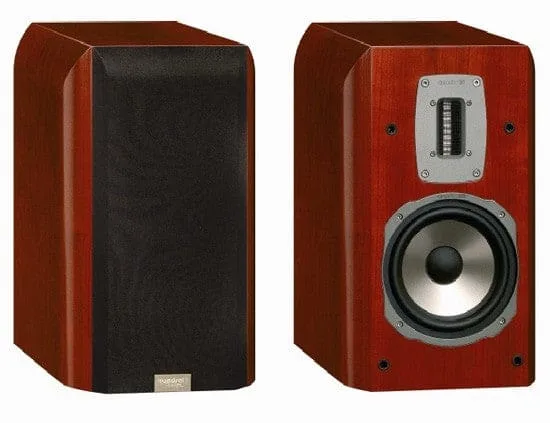

Quadral Rondo
2-way bass-reflex bookshelf speaker from Quadral, combining a ribbon tweeter with a 17 cm ALTIMA woofer/midrange, for enthusiasts of precise listening in a compact format.
Comparison with the observed price of the same product new; this is not a reduction on a previous price.
Description
The Quadral Rondo is a two-way bookshelf speaker with bass-reflex loading. It is aimed at those seeking a compact format without giving up on refined sound reproduction, particularly at the top of the spectrum.
The woofer/midrange driver measures 17 cm and uses an ALTIMA alloy diaphragm, a proprietary material combining aluminium, magnesium and titanium. This composition aims to combine rigidity and lightness, two qualities that limit diaphragm distortion and promote accurate reproduction of the midrange and bass. The top of the spectrum is handled by a ribbon tweeter, a technology that allows the treble bandwidth to be extended with finesse. The crossover frequency between the two drivers is set at 3,500 Hz.
With an impedance of 4 Ω, the Rondo requires an amplifier capable of delivering current without faltering, which points its pairing towards solid electronics rather than small entry-level amplifiers. Its sensitivity of 86 dB also implies sufficient power is needed to achieve a comfortable sound level.
This model is aimed at a music enthusiast listening at low to medium volume, with an amplifier suited to a 4 Ω load, and wishing to enjoy the particular texture of a ribbon tweeter rather than a conventional dome.
Technical specifications
| Type | 2-way bookshelf speaker, bass-reflex |
| Drivers | 17 cm ALTIMA bass-midrange + ribbon tweeter |
| Sensitivity | 86 dB (1 W / 1 m) |
| Impedance | 4 Ω |
| Crossover frequency | 3,500 Hz |
| Power handling | 50 W (nominal) / 80 W (music) |
What to check before buying used
The ALTIMA diaphragm holds up well over time, but check for cracks or impact marks around its edge as well as the condition of the woofer/midrange's surround, which can stiffen or come away over the years. Also inspect the tweeter's ribbon, a delicate component that poor transport or a power overload can deform or irreparably damage. Finally, examine the cabinet and veneer at the corners, along with the bass-reflex port, to rule out any swelling or lifting of the panel.
Looking for a specific product?
Tell us what you are looking for: our merchants are notified, and one of them may have it in stock.