
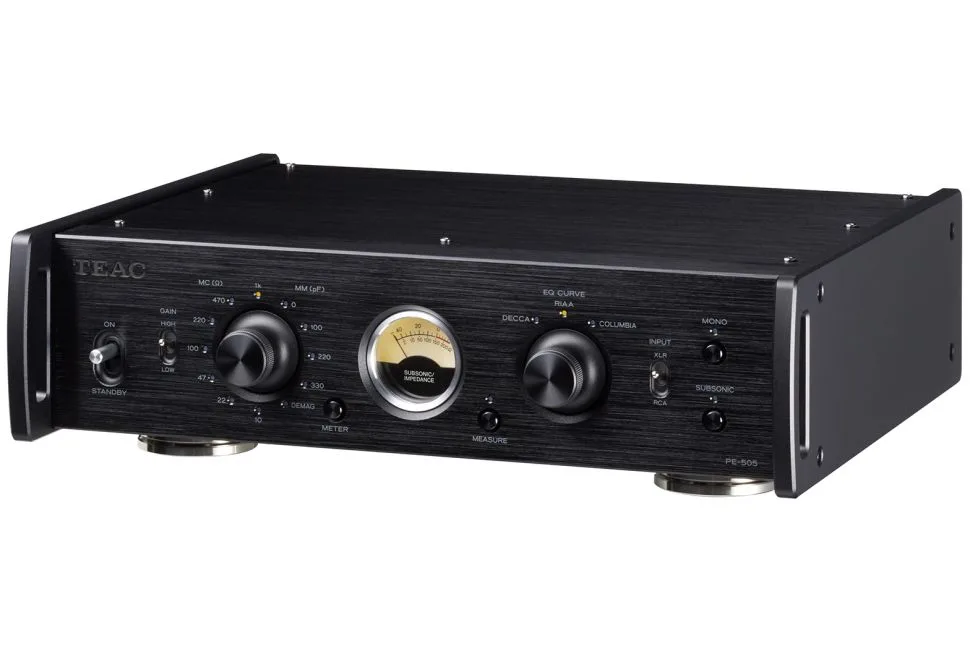

TEAC PE-505
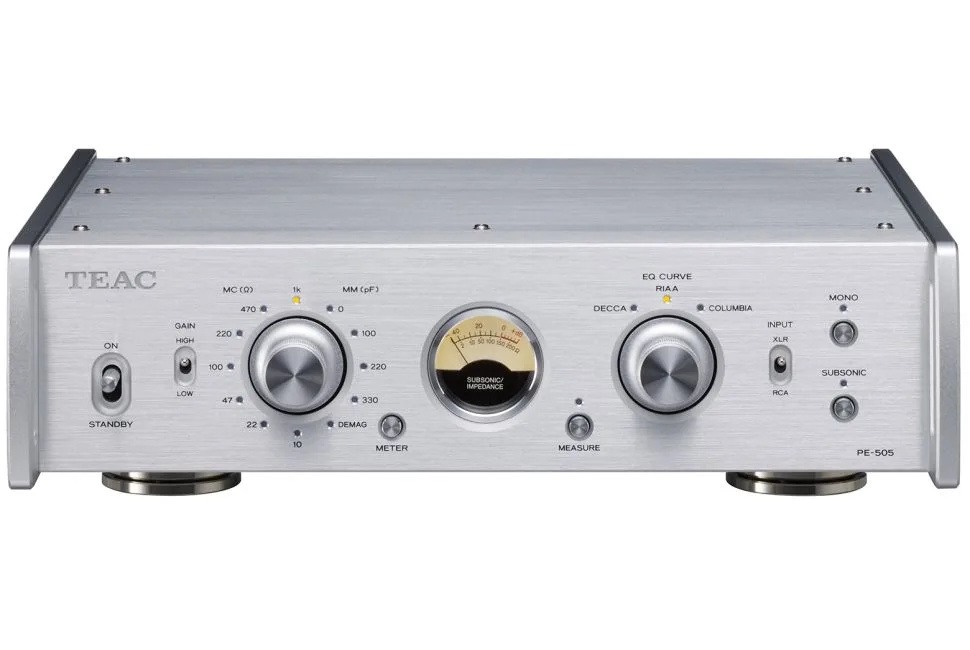
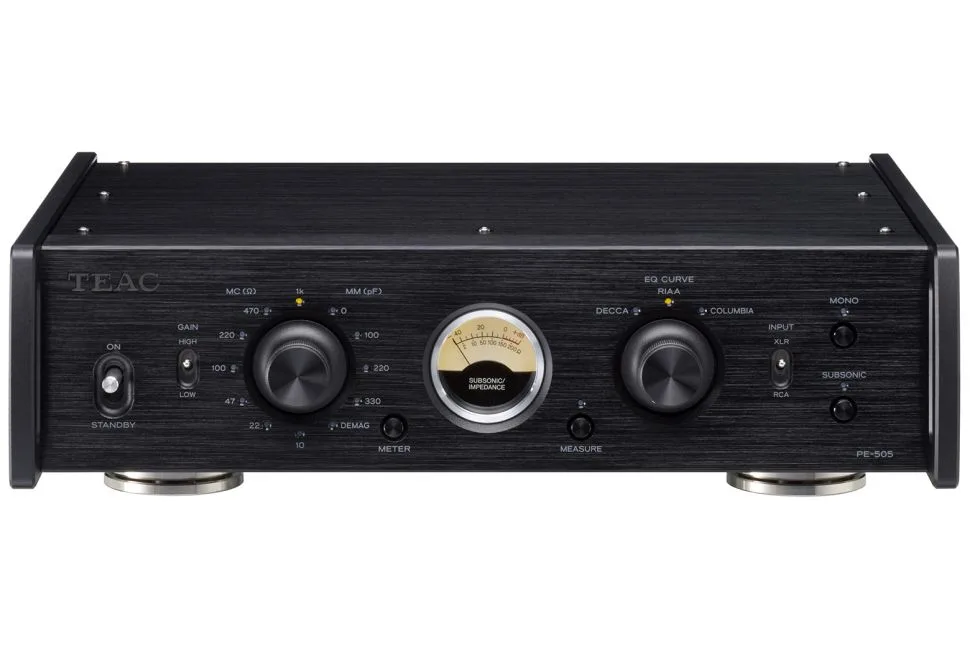
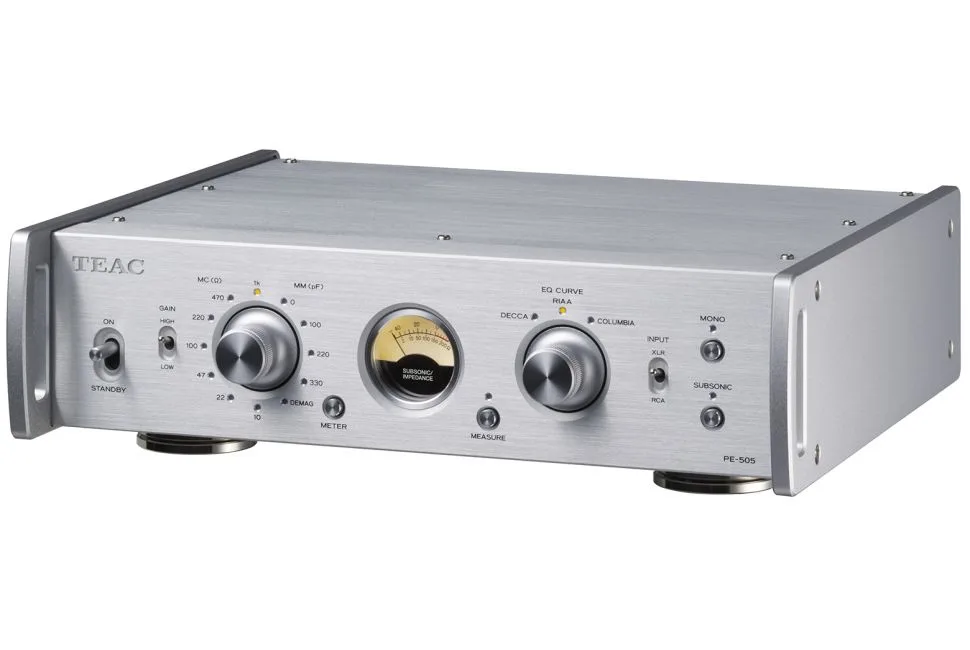
TEAC PE-505 phono preamplifier with fully balanced, dual-mono circuitry, compatible with MM and MC cartridges, featuring three equalisation curves: RIAA, DECCA and Columbia.
Description
The TEAC PE-505 is a phono preamplifier dedicated to amplifying and equalising signals from a turntable cartridge. It stands out for its fully balanced, dual-mono architecture, applied to every stage of the circuit, from the head amplifier through to the final output stage.
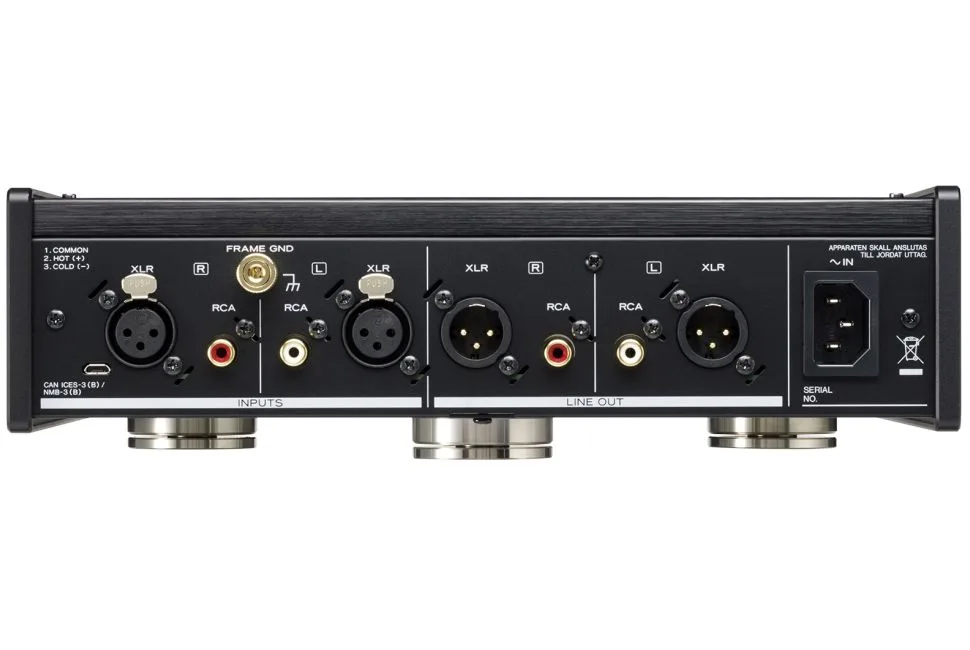
All internal stages, including RIAA EQ amplification, maintain a balanced input and output configuration in order to preserve the purity of the signal, which is particularly weak at the cartridge output. Even the RCA input, inherently unbalanced, is converted to differential transmission as soon as it enters the unit. A differential output averaging circuit then absorbs discrepancies between the positive and negative outputs, thanks to a differential amplifier configuration with cross-coupled outputs.
Beyond the standard RIAA curve, the PE-505 incorporates two historic equalisation curves, DECCA and Columbia, each with its own independent circuit. This approach allows for more faithful reproduction of older records pressed according to these specific equalisation standards, without relying on a single equalisation compromise.
On the cartridge side, the PE-505 offers load capacitance switching for MM models and load resistance switching for MC models. A built-in measurement function, accessed via a dedicated button, allows the MC cartridge's load resistance value, including cabling, to be displayed on a meter for precise adjustment of this parameter. The unit also features a subsonic meter detecting components below 6 Hz, as well as an adjustable subsonic filter set at 17 Hz with a slope of -24 dB/octave, designed to eliminate unwanted low frequencies outside the audible spectrum.
This preamplifier is aimed at vinyl enthusiasts with a turntable fitted with an MM or MC cartridge who wish to refine phono reproduction beyond a simple generic RIAA equalisation, particularly for listening to older pressings compatible with the DECCA or Columbia curves. Its balanced configuration will also appeal to systems featuring XLR inputs on the amplifier or line preamplifier.
Technical specifications
| Equalisation curves | RIAA, DECCA, Columbia |
| Total harmonic distortion (RCA input MM, LOW GAIN) | 0.002 % |
| Total harmonic distortion (RCA input MC, LOW GAIN) | 0.02 % |
| Total harmonic distortion (XLR input MC, LOW GAIN) | 0.02 % |
| Signal to noise ratio (RCA input MM, LOW GAIN, IHF A) | 106 dB |
| Signal to noise ratio (XLR input MC, LOW GAIN, IHF A) | 86 dB |
| RIAA deviation (20 Hz to 20 kHz) | ±0.05 dB |
| Channel separation (MM, 10 kHz, LOW GAIN) | -90 dB or better |
| Gain (LOW GAIN, RCA input MM) | 34 dB |
| Gain (LOW GAIN, RCA input MC) | 54 dB |
| Gain (LOW GAIN, XLR input MC) | 54 dB |
| Gain (HIGH GAIN, RCA input MM) | 46 dB |
| Gain (HIGH GAIN, RCA input MC) | 66 dB |
| Gain (HIGH GAIN, XLR input MC) | 66 dB |
| Subsonic filter | 17 Hz, -24 dB/octave |
| Dimensions (H × W × D) | 84.5 × 290 × 252.5 mm |
| Weight | 4.5 kg |
What to check before buying used
On this type of phono preamplifier, the XLR and RCA connectors deserve careful inspection: contact oxidation, mechanical play or poor contact can introduce noise or unbalance the channels. The equalisation curve switches (RIAA, DECCA, Columbia) and gain switches, rarely used on some units, should be tested through their full range to detect any crackling. Checking the internal capacitors also remains worthwhile depending on the age of the unit, as these components can drift over time and affect equalisation accuracy.
Looking for this reference: PE-505 ?
Tell us what you are looking for: our merchants are notified, and one of them may have it in stock.