
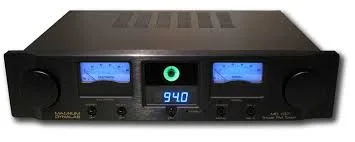
Magnum Dynalab MD107 T
Hybrid FM tuner from Magnum Dynalab, fitted with a valve audio amplification stage, designed for enthusiasts of high fidelity radio reception.
Description
The MD107T is a hybrid FM tuner from Magnum Dynalab, designed for FM band reception with particular attention paid to sound quality. It occupies a special place in the manufacturer's range: it is the brand's first tuner to incorporate a valve audio amplification stage, while retaining an entirely analogue radio frequency reception section.
The design of the MD107T is based on a clean separation between the RF section, responsible for capturing and demodulating the radio signal, and the audio section, responsible for amplifying it before output. This approach allows an in-house developed analogue reception front end to be paired with a valve output stage, renowned for its distinctive sonic colouration. The tuner's front end is designed and manufactured by Magnum Dynalab itself, with a five-step alignment process and manual assembly of components in areas deemed critical for signal sensitivity and selectivity.
This tuner is aimed at listeners seeking an FM listening experience close to that of valve amplifiers, with the characteristic sonic warmth of this technology applied this time to a tuner. It will particularly suit high fidelity radio enthusiasts who already have a system built around valve components, or who wish to introduce this sound into their setup via the radio source.
Technical specifications
| Valves | MD Reference 6922 (positions 1 and 2) |
| Frequency response | 15 Hz – 17 kHz |
| Sensitivity | 0.7 µV / 9.0 dBf |
| Signal to noise ratio | 80.0 dB |
| Total harmonic distortion | 0.10 % (mono), 0.18 % (stereo) |
| Channel separation | 50.0 dB |
| Analogue outputs | RCA line output 1.0 V; balanced output 2.2 V |
| Power consumption | 50 W (max) |
What to check before buying used
On this hybrid tuner, the valve output stage deserves priority checking: verify the condition of the valve (micro-cutouts, background noise, hum) and that it sits correctly in its socket. The manually assembled RF reception front end can drift over time: test sensitivity and selectivity on several stations, including weak ones, to detect any alignment issues. Finally, inspect the cleanliness of the potentiometers and front panel controls, which are often prone to crackling after several years of use.
Looking for this reference: MD107 T ?
Tell us what you are looking for: our merchants are notified, and one of them may have it in stock.